Use SAXS when the important features in your material sit at the nano- to mesoscale rather than in the crystal lattice. It is well suited for studying particle size, pore structure, domain spacing, aggregation, and density inhomogeneity in systems such as porous materials, polymers, nanocomposites, and colloidal particles.
Measurement technique
Small-angle X-ray scattering
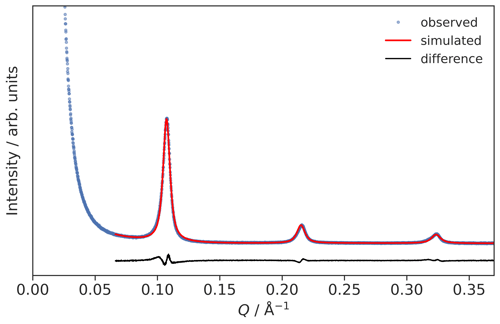
Small-angle X-ray scattering (SAXS) probes the material over very low spatial frequencies. This allows observations of inhomogeneity or periodicity in the density, which can be particularly useful for identifying microphase segregation or mesoporosity.
What information do you get out of it?
SAXS gives access to characteristic size scales, shape information, surface-to-volume relationships, and ordering on longer length scales than conventional diffraction. It is particularly useful for identifying mesoporosity, microphase segregation, aggregate formation, and nanoscale structural evolution during synthesis or processing.
Deliverables
Reduced SAXS profile with calibrated scattering vector axis
Experimental report with acquisition parameters and data quality summary
Data package suitable for model fitting or comparative screening
Optional add-on support for SAXS fitting and nanoscale structure interpretation
Ready to get started?
Use SAXS in your next measurement campaign
Send your samples, choose the workflow that fits your material, and we will handle measurement, processing, and delivery.