Single Atom Catalyst Detection
Detecting single atom catalysts via the difference pair distribution function method
Measure your first 5 samples for freeChallenges
-
Randomly dispersed single atom sites
It is extremely challenging to detect the presence of single atom sites when they are dispersed randomly within a support material.
-
Distinguishing from nanoparticles
Few methods can provide quantitative validation of local coordination environments or distinguish single atom sites from small nanoparticles.
Example: Pd single-atom catalysts in covalent organic frameworks
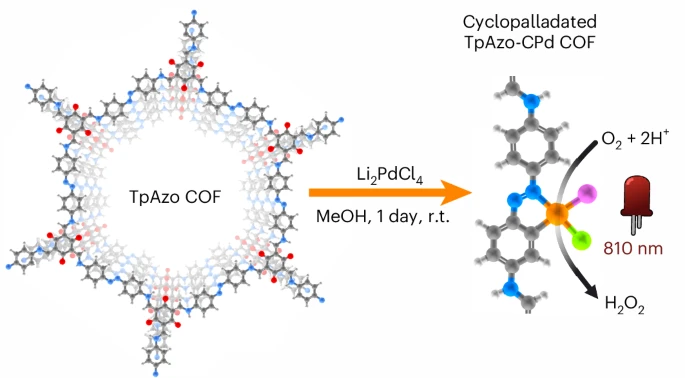
Pd single-atom catalyst complexes are installed into a covalent organic framework. Cyclopalladation red-shifts the absorption edge, enabling photocatalytic activity under NIR light (810 nm). Pd facilitates charge transfer and suppresses recombination for photocatalytic hydrogen peroxide production.
Rodríguez-Camargo et al. Nat. Synth (2025) 4, 710–719.
License: CC BY 4.0Result
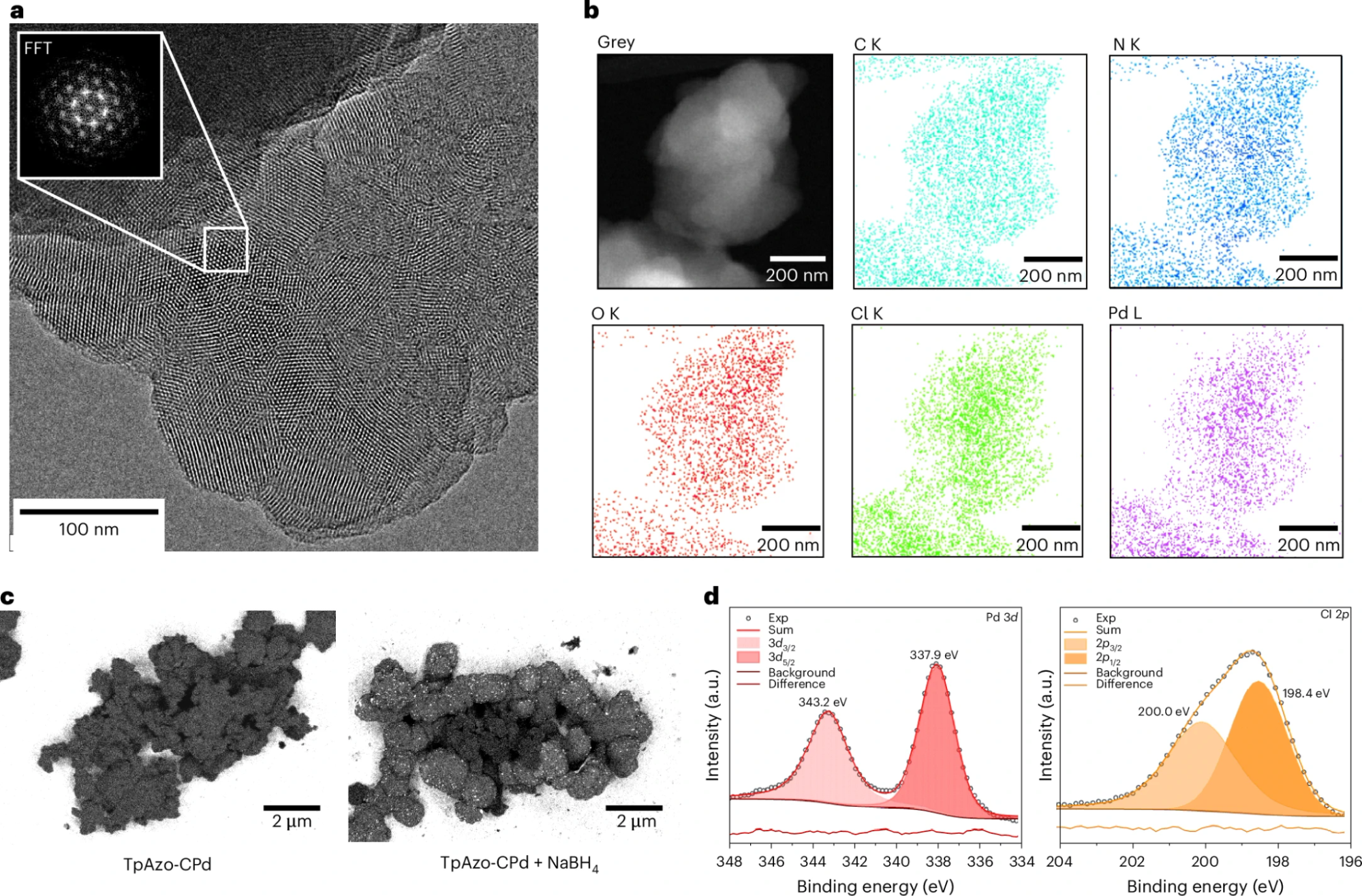
Transmission electron microscopy supports COF crystallinity while STEM–EDX elemental mapping analysis shows Pd & Cl uniformly distributed. XPS suggests Pd(II) ions in complexes.
Remaining questions
-
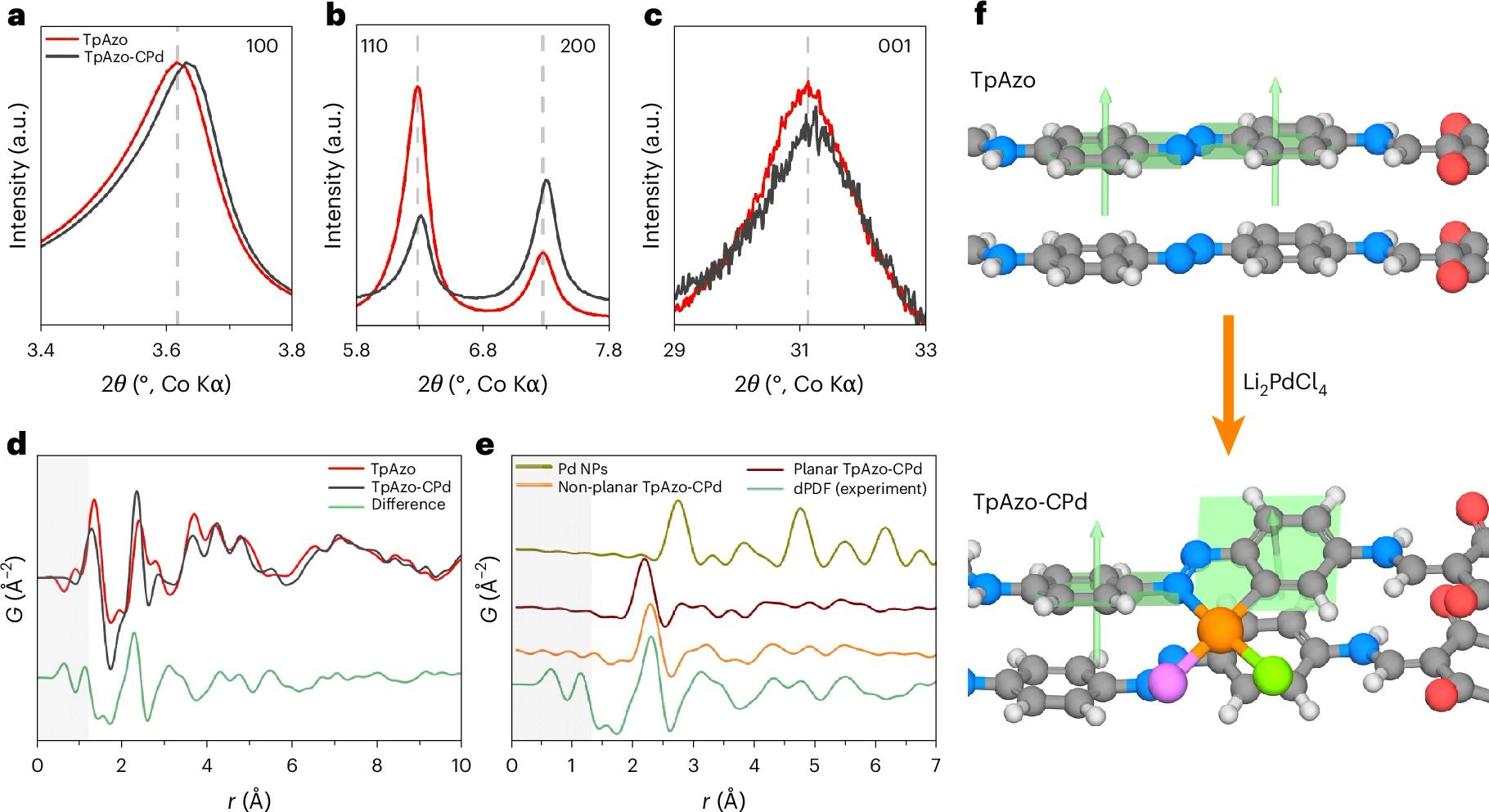
What is the nature of the binding configuration?
-
Are there any Pd nanoparticles formed?
Rodríguez-Camargo et al. Nat. Synth (2025) 4, 710-719
License: CC BY 4.0X-ray diffraction and difference pair distribution function analysis results:
- Diffraction indicates contraction along the in-plane and stacking directions with complexes loaded.
- Difference PDF analysis:
- Verifies the presence and identity of Pd complexes formed
- Proves that nanoparticle formation is insignificant
- Indicates that conformational changes accompany complexation explaining the contracted structural state.
Signal sensitivity
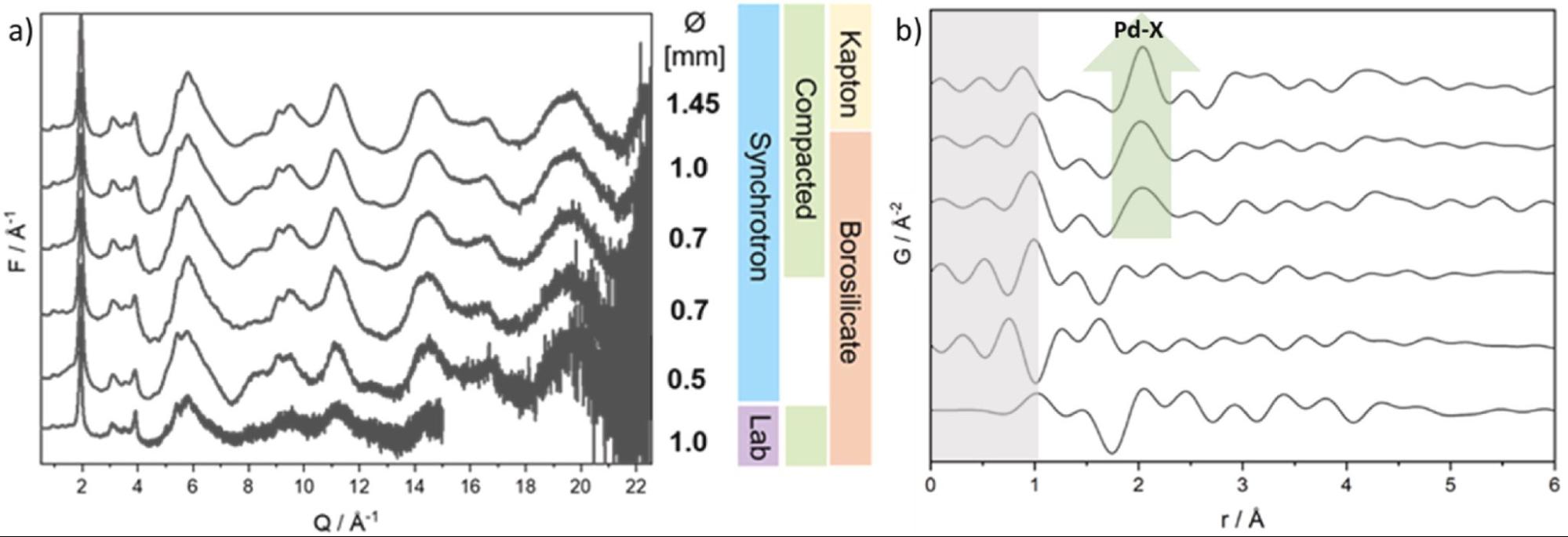
- Signal-to-noise of instrument and sample preparation are key factors to success
- Requires synchrotron radiation. Sensitivity generally not achieved with laboratory diffractometers (even with 24h measurement).
- Signal extraction is non-trivial and requires data processing by experienced personnel.
Kappel et al. Mater. Today Chem. (2025) 47, 102776
License: CC BY 4.0Problems with standard analysis method
-
Localized complexes and single-atom catalysts are non-periodic and therefore do not diffract sharp signals.
-
The isolation of signals in reciprocal space is non-trivial.
Benefits of our method
-
PDF directly probes localized catalytic sites
Provides more intuitive means for signal extraction and directly probes structuring of local sites.
-
High-sensitivity candidate model testing
Allows for convenient testing of candidate models with high sensitivity, distinguishing single atoms from nanoparticles.
-
Synchrotron-grade signal quality
Signal extraction is non-trivial and requires data processing by experienced personnel—our service handles this end-to-end.
Explore more applications
Ready to characterize your materials?
Get synchrotron-quality X-ray data for your application—no proposals, no beamline scheduling.