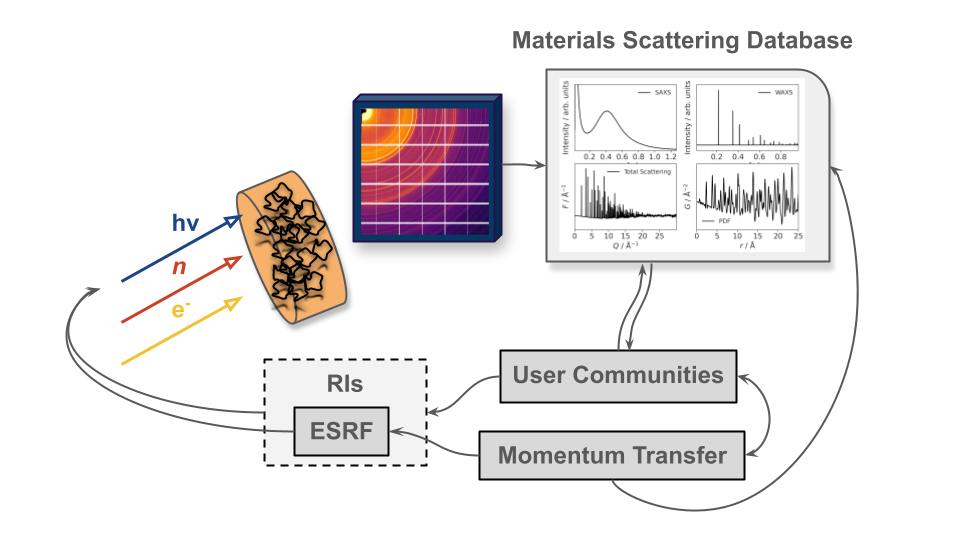
At Momentum Transfer, we are excited to invite researchers from various fields to apply for a unique opportunity: contributing to the Materials Scattering Network, an Open Science initiative funded by OSCARS. This initiative allows researchers to gain access to high-resolution powder X-ray diffraction (PXRD) and total scattering pair distribution function (PDF) data from world-class synchrotron facilities while contributing to an open-access global database for materials scattering data.
What is OSCARS?
OSCARS (Open Science Clusters’ Action for Research & Society) is an EU-supported initiative to bring together research infrastructures to foster the uptake of Open Science and provide FAIR data management policies and practices. Fair principles include findability, accessibility, interoperability, and reusability. OSCARS is now supporting the Materials Scattering Network (MatScatNet) project by Momentum Transfer, designed to build an open-access database of experimental scattering data. In that context, we are specifically focused on expanding the global availability of PXRD and total scattering PDF data, which will benefit researchers working in materials science, chemistry, physics, engineering, and related fields.
Researchers from around the world are encouraged to apply, submitting their most interesting samples to be measured at the ESRF synchrotron in Grenoble. Participants will receive high-resolution PXRD and total scattering PDF data that provide deep insights into both crystalline and amorphous materials structuring and properties. In return, their contributions will help expand the database, aimed to become a global resource for accelerating scientific discovery through open data.
Driving open science in materials research: why this initiative matters
MatScatNet is grounded in the belief that openly accessible, high-quality experimental data are essential for advancing materials research. Currently, powder diffraction and total scattering data are underutilised due to technical barriers, data inaccessibility, and the complexity of analysis tools. We aim to lower these barriers by creating a unified, open-access database. This will facilitate easier materials analysis for new research projects, enable large-scale meta-analyses for materials discovery, and help cultivate an interdisciplinary open science infrastructure.
By making synchrotron data openly accessible, MatScatNet helps foster a more comprehensive understanding of crystalline and amorphous materials. This resource allows researchers to explore properties of material structures in ways that support advancements in areas such as energy materials, filtration technologies, medicine, construction materials, and more.
A primary outcome of MatScatNet will be the unification of currently segmented research communities that use scattering techniques for materials research and development. Through simplified data interpretation and accessible tools, the project reduces the need for specialised expertise and enhances interdisciplinary collaboration, offering new perspectives on existing data and creating a more connected, efficient research community.
Furthermore, by developing advanced data retrieval and analysis tools, MatScatNet extends the scientific lifetime and usability of each dataset. New algorithms enable efficient data searches and support scientists in matching experimental results with major repositories, ensuring that both current and future researchers continue to benefit from this global scientific resource.
Why should researchers contribute?
Access to high-quality data
By participating in the Materials Scattering Network, researchers can obtain high-quality data for up to five of their samples measured at the upgraded ESRF synchrotron. These advanced measurements deliver enhanced resolution and signal-to-noise ratios, offering insights that are often beyond the capabilities of typical laboratory-based equipment. This means your research will benefit from state-of-the-art methods, potentially leading to new breakthroughs and discoveries.
Contribute to a Global Scientific Resource
Through the Materials Scattering Network, a key goal of Momentum Transfer is to create a comprehensive, open-access database that will be freely available to the scientific community. By participating, researchers not only enhance their own research but also contribute to a valuable global resource that fosters collaboration and open science. This collective effort will advance materials research and support scientists from a wide range of disciplines.
Want to Participate?
Take this opportunity to join a global Open Science movement and shape the future of materials science! As a participant, you’ll gain access to world-class synchrotron measurements and contribute useful content to a growing open-access database. Find all details on how to apply here. Discover how you can elevate your research and advance materials science through open data collaboration.
Data Privacy and Control
An embargo will be applied to ensure that researchers have ample time to complete their studies before data are published in the database. Embargo periods may be extended if more time is needed, and researchers will be acknowledged for their contributions.