Structure Solution of Active Ingredients
Crystal structure solution and formulation analysis
Measure your first 5 samples for free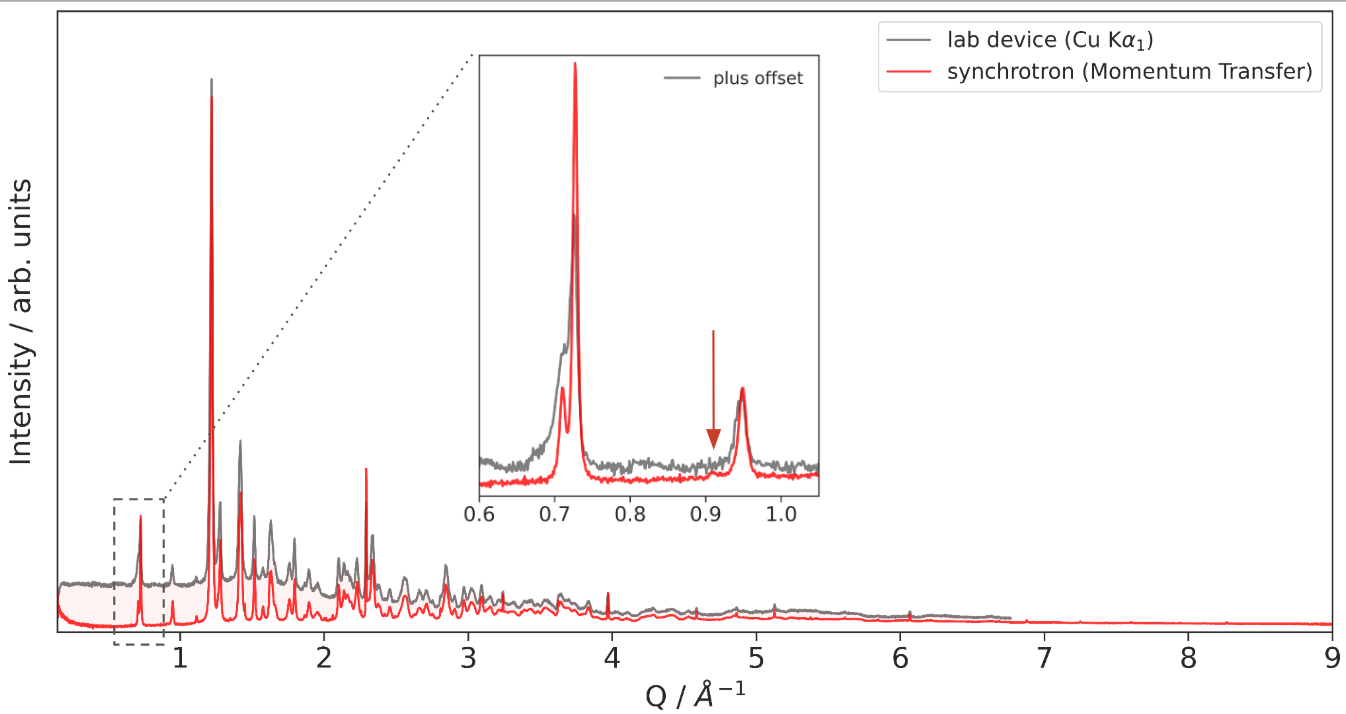
Challenges
-
Legacy compounds lack structural data
Many industrial compounds predate modern regulation standards. Some have been in use for decades—such as the agrochemical fungicide Metiram—without complete knowledge of their chemical structure and properties. This knowledge is critical for safety, quality control, and for developing more effective products.
-
Regulatory and IP requirements
New active ingredients require detailed identification and evaluation to meet modern safety and efficacy standards for regulatory approval, as well as for IP protection. Without structural clarity, compounds cannot be properly differentiated—leading to regulatory and analytical confusion.
-
Limited access to techniques and expertise
In the past, access to high-quality data, optimized tools for analysis, and expertise were limited. Momentum Transfer makes it easy for everyone to pursue these powerful techniques and access the most complete information about their materials.
A brief history of EBDTC's in agrochemicals:
Metiram and Zineb were often treated as synonymous in regulatory documents and databases, despite being distinct compounds with different structures and properties.
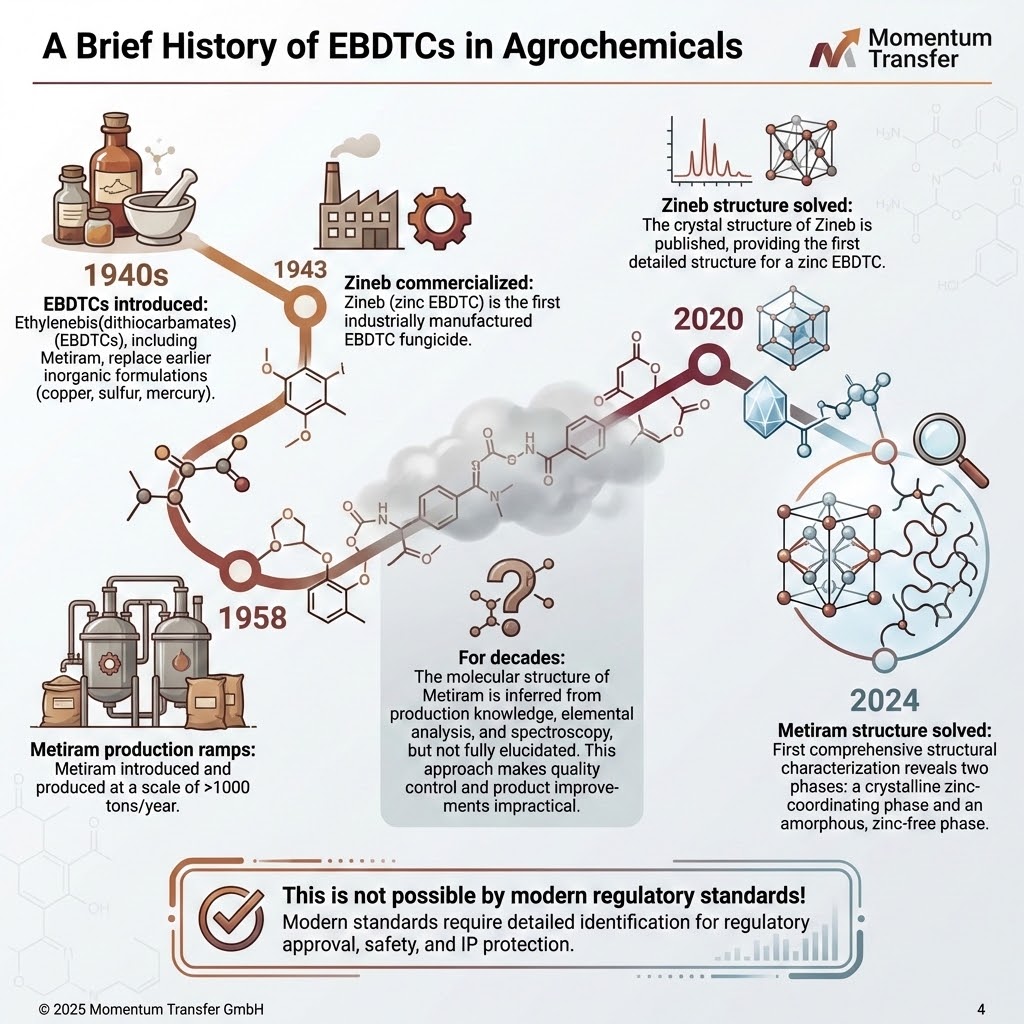
Unclear molecular structure and phase composition—different sources published varying molecular formulas and structural depictions for Metiram, with unspecified or inconsistent stoichiometry.
Without detailed structural information, it was difficult to differentiate Metiram from other EBDTC fungicides (such as Zineb, Maneb, and Mancozeb) at the molecular level, leading to regulatory and analytical confusion.
Benefits of our method
-
Improved resolution
Better separation of diffraction features improves unit cell indexing and the determination of lattice parameters, crystallite size, and microstrain.
-
No background signal
Background is accurately measured and accounted for—all scattering signals come from the sample, improving sensitivity to diffuse features and allowing easier use of full scattering information.
-
Enhanced signal-to-noise
Higher sensitivity to small diffraction features and presence of impurities. Clear identification and quantification of impurities (ammonium chloride).
-
Better spatial resolution
Collection to larger values of Q correspond to smaller d-spacings and higher sensitivity to molecular conformation.
Results
- High-resolution data allow for better convergence of the correct molecular conformation.
- Clear identification and quantification of impurities (ammonium chloride).
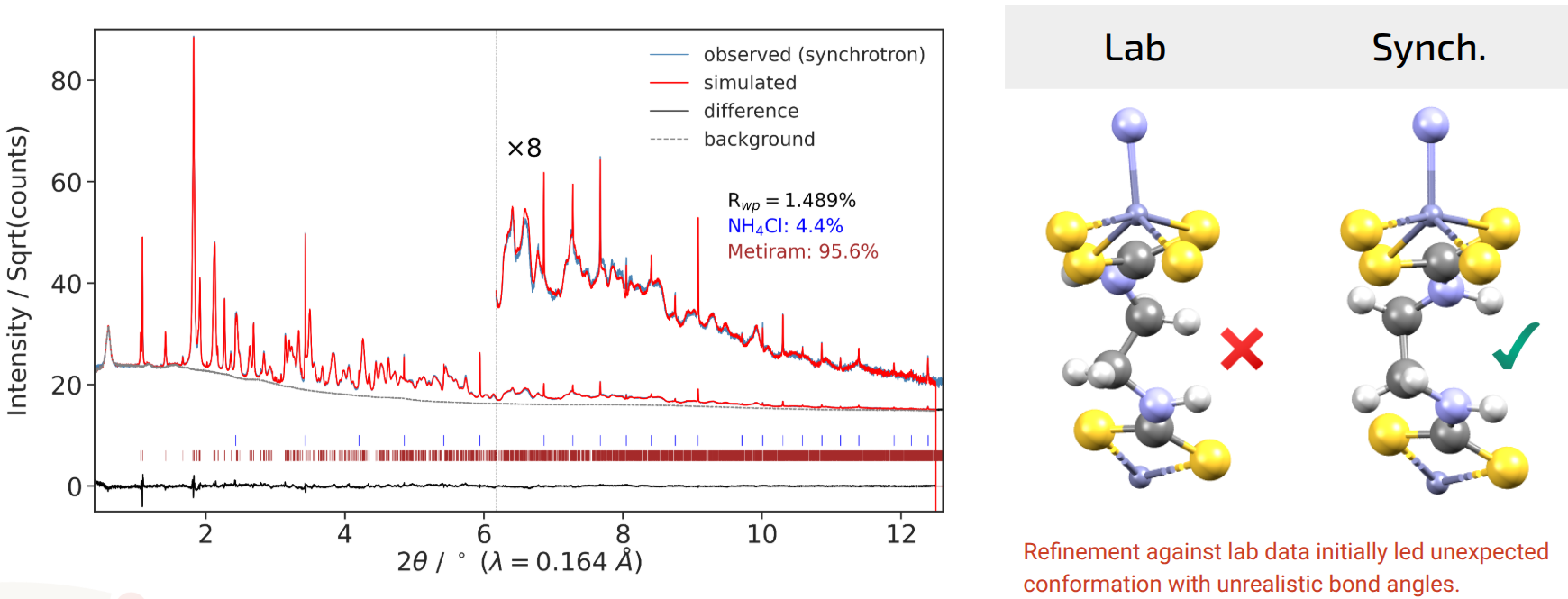
Results of structure solution and Rietveld refinement. Dinnebier et al. Cryst. Growth Des. 2024, 24, 20, 8185–8202.
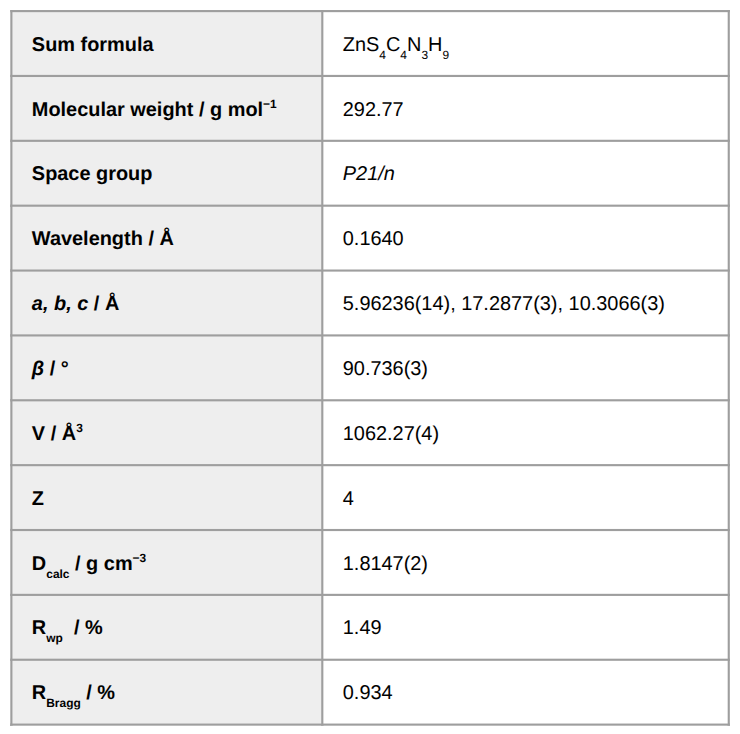
This investigation helped determine
-
Metiram consists of two distinct phases: phase I (crystalline) makes up approximately 81 wt% of the material with phase II (amorphous) makes up about 19 wt% of the material.
-
Phase I crystallizes in the monoclinic space group P2₁/n and features one-dimensional S-shaped chains of Zn[NH₃][S₄] polyhedra, where Zn²⁺ is coordinated by four sulfur atoms and one ammonia molecule.
-
All Zn²⁺ is exclusively associated with the crystalline phase; the amorphous phase is essentially zinc-free.
-
The clarified structure allows for unambiguous identification of Metiram, distinguishing it from related EBDTC fungicides (such as Zineb), and resolves previous confusion in regulatory and analytical contexts.
Explore more applications
Mineral Detection & Quantification
Quantifying mineral species in mining and geological samples
Nanocatalyst Phase Quantification
Phase identification & quantification for supported nanocatalysts
Single Atom Catalyst Detection
Detecting single atom catalysts via the difference pair distribution function method
Ready to characterize your materials?
Get synchrotron-quality X-ray data for your application—no proposals, no beamline scheduling.